
The “E” Path to Hope

Broken people who are tending to their injuries from loss, struggle to face the future; sometimes it’s an effort to take their next breath. It is difficult to press forward when memories of what they lost keep pulling them back. It is hard not to become cynical, believing Murphy’s Law—that if anything can go wrong, it will.

The E path challenges every negative attitude that has burrowed in our minds and persistently pushes us toward hope. I believe this was the prophet Jeremiah’s experience.  

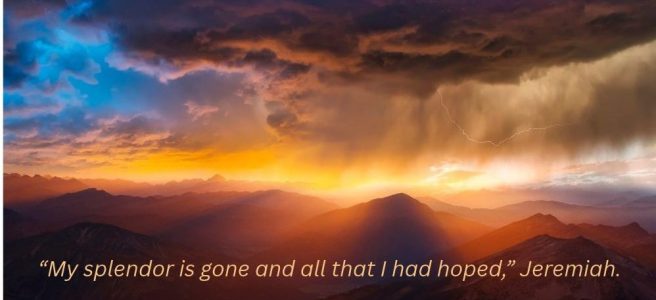
Jeremiah wrote chapters about the hardships that befell him… We feel his pain and identify with the words he penned: “My splendor is gone and all that I had hoped from the Lord. I remember my affliction and my wandering, the bitterness… and my soul is downcast within me.”

Can you identify?

Read on because Jeremiah’s words don’t end there. He adds a “yet.”

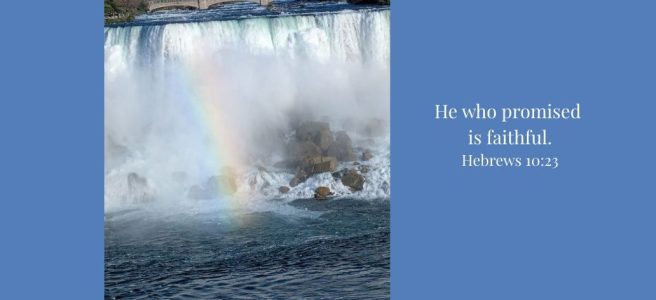
“Yet…this I call to mind and therefore I have hope: Because of the Lord’s great love we are not consumed, for His compassions never fail. They are new every morning; great is your faithfulness” (Lamentations 3:22-23).

The E of Hope is too full for me to share adequately in a short post, so I will jump to my book’s grand conclusion, a testimony formed when I was scrounging for hope. I learned to reject feelings and push against my emotions. Instead, I chose to Expect Grace. The pain of my losses remains, but I echo Jeremiah: “Yet… I have hope.” God’s grace is fresh every day, and His faithfulness is new every morning.*

* The full text is found in chapter nine of I Was Broken, Too: Four Paths to Restore Hope

Image by Pixabay

The “P” Path to Hope

Are you ready for the third pathway to hope? The “P” path challenges our minds to Ponder the Positive, not the Problem.

If we allow our thoughts to follow their natural inclination, they will drift to life’s disappointments.

Left unchecked, this default setting invites us to obsess over our problems. We examine them from every angle, turning them over and over again in our minds. We waste an untold number of words and far too much time rehearsing the details of our challenges… One of the quickest ways to devastate hope is to let this pattern go unchecked. If our mind dwells only on our problems, we are blinded to the enormity of God’s promises and the goodness of His nature…
As true as our troubles are, there is a greater Truth.     

Immersing ourselves in the Word is our lifeline. It will overrule our emotions with truth, assure us of God’s faithful presence, and promise us a future with hope. As we ponder the positive affirmations we find there, we will be made strong and become overcomers.

How could I ponder the positive when my daughter’s death had plunged me into the negative? I saw no light, only loss. My saving grace was my confidence in God’s character and respect for His sovereignty. Bit by bit, revelations of  His goodness formed thoughts of gratitude that became my testimony. Pondering those thoughts rescued me.

I invite you to reset your default setting. Don’t rehearse the details of your pain, but feed your faith in God by filling your mind with the truths in His Word.

Excerpted from I Was Broken, Too: Four Paths to Restore Hope, chapters seven and eight.
Image by Pixabay

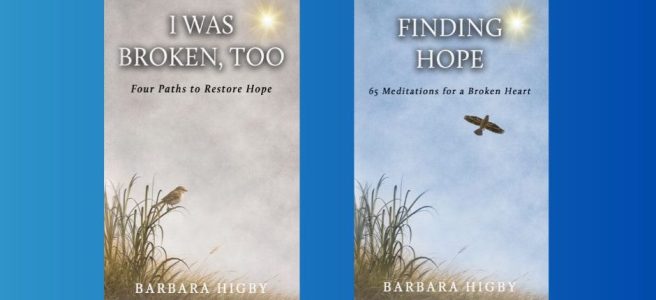
Now available on Amazon:
I Was Broken, Too: Four Paths to Restore Hope
Finding Hope: 65 Meditations for a Broken Heart

The “O” Path to Hope

This may be the most challenging path on the journey to restoring hope. More than a change of focus and attitude, the “O” path calls for forward movement: Open your Heart to God’s Opportunities. It asks us to trust God’s plans.

“I know the plans I have for you,” declares the Lord,
“plans to prosper you and not to harm you, plans to give you hope and a future.”

We love these words from Jeremiah 29:11… until we are asked to step into the unknown. But what’s the alternative for broken people? Remain where we are, weeping and regretting? Prosperity, hope, and a future are plans we cannot afford to ignore. Let’s trust God.

God never changes, but His methods are fluid, and His timelines are His secret. Will we be open enough, flexible enough, daring enough to follow Him into uncharted territory?… 

When God entrusts us with visions and dreams, they are not ours to mold according to our understanding. They are His to unfold in His time, according to His wisdom. He often inspires dreams for reasons we don’t understand, and when He brings us down an unexpected path, we have a choice. We can yield to our fears and seal the door of our hearts, or in faith, we can throw the door open and invite the Spirit to accomplish purposes known only to Him. Every twist, diversion, or detour leads to a future He alone sees. Hiding behind the safety of closed doors will rob us of the joy of obedience…

The good plans God prepared for us need space and freedom to grow. He doesn’t impose them on us—we need to accommodate them and rid ourselves of emotional chaos. If former hopes and dreams have changed, it’s time to clean house and make room for the new…

My testimony is this:

An open heart became an open door for God’s opportunity, and hope persevered through the darkness.

I hope this encourages you to trust God in the unknown and step into your future.

Excerpts from I Was Broken, Too, chapters five and six.
Image by Cara Shelton from Pixabay

Now available on Amazon:
I Was Broken, Too: Four Paths to Restore Hope
Finding Hope: 65 Meditations for a Broken Heart

The “H” Path to Hope

Maybe your own brokenness will help you relate to the Israelites of old. Like you, they were in a place they didn’t want to be, held captive by adverse circumstances, enslaved in a strange land, and overwhelmed with dismay. When you were wrested from your safe environment, you may have reacted as they did, weeping over bittersweet memories: 

“Beside the rivers of Babylon, we sat and wept as we thought of Jerusalem.”
Psalm 137:1

They wept with longing—for home, for a normal life, for a way out. And they complained.

Perhaps your questions and complaints are similar to theirs. Didn’t God see their plight? Didn’t He care about their pain?… Where was He now?

Isaiah asked the Israelites a series of questions that would lead them to the answer. “Do you not know?… Have you not heard? Has it not been told you from the beginning? Have you not understood since the earth was founded? He [God] sits enthroned above the circle of the earth” (Isaiah 40:22).

In effect, he was saying, “You’re looking for God’s presence—apparently you’ve forgotten that He is here and has been since the earth came into being.” God has not forgotten you. He is not unaware of your suffering. He has not abandoned you…

Isaiah offered them the H of hope: Lift up your eyes…

In chapter I reflected on daughter Stacey’s death:

I was shattered. My prayers were moans… And yet, in that trupor of grief, God’s grace pulled my eyes upward, compelling me to hold them higher.

Tenaciously, without cooperative emotions or enlightened understanding, I forced my eyes to look to the heavens, to the One who created and ruled my personal world. It was there that the threat of despair was beaten back…

Hold your eyes higher than your earthbound problems and look at the One who is above it all—you will find hope. It worked for me, and it will work for you.*

Next week, we will step onto the “O” Path.

*Excerpted from I Was Broken, Too, chapters three and four.

Now available on Amazon: I Was Broken, Too: Four Paths to Restore Hope and Finding Hope: 65 Meditations for a Broken Heart

Image by Sasin Tipchai from Pixabay