
Wedding Thoughts

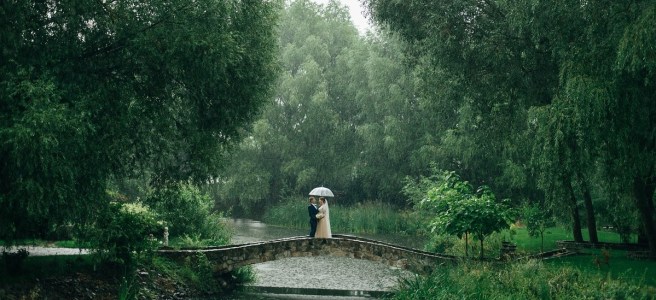
As I read through Jesus’ parables I noted that two were about a wedding—His wedding. We’re all invited and it will be like none we’ve ever attended. It will be the wedding of all weddings. The beauty, the vows, and the feast will supersede anything we’ve experienced. Take a look and see if you can identify the “R” word I designated to each parable.

Jesus’ describes a lavish wedding banquet prepared by a king for his son. Amazingly, when the servants invited guests, they didn’t come—actually, it says they refused to come. It seems that most were too busy but others reacted to the invitation with violence, killing the messengers. This did not change the king’s plans—the banquet would be held, the celebration was planned and anticipated, all of time and history pointed to this singular event. So he sent his servants to the streets and they invited all the people they could find, “the bad as well as the good, and the wedding hall was filled” (Matt 22:10).

A second parable tells of ten young women waiting for the groom to arrive for his wedding banquet. He had been so long in coming the women fell asleep. When the wake-up call awoke them, five discovered their lamps had burned out and they were without oil. The other five, known as the wise virgins, were prepared with extra oil—they didn’t risk being left out. Jesus’ closing words in His story were, “Therefore keep watch, because you do not know the day or the hour” (Matt 25:13).

The two R’s I came away with were these: Be responsive. Be ready.

It is a wedding feast we will not want to miss.

Finding Hope, 65 Meditations for a Broken Heart
The Samaritan and the Bike

The Good Samaritan, part 2

We lived on a hill in Midland Park. Most residents do. You only need to walk five minutes out the door to find yourself going uphill or down. This is an important element to my story.

Our son David did not have the mental acuity or physical dexterity to ride a bike so we bought him an adult tricycle. The slope of our driveway challenged him—he coasted down but he couldn’t pedal back up. Though his ability was limited, he enjoyed his trike and stayed within the parameters of the driveway—until the day he didn’t.

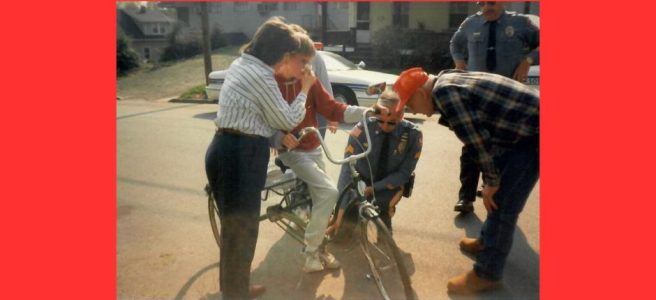
Did I mention we lived on a hill? He turned out of the driveway but only went six feet when his bike began to roll back. David put his feet down to stop the momentum but his skinny little leg got trapped between the pedal and the bike. I couldn’t roll him forward and I didn’t have the strength to pull the pedal away from the frame. Since the neighborhood men were at work, I called the police, hoping they would be able to pull out pedal and release David’s leg.

Flashing red lights announced their arrival and, though they gave it their best effort, they couldn’t budge the pedal. So they called the fire department. Two engines arrived with sirens blaring and more flashing lights. One pulled up behind the police car, the other blocked the end of the road. Neighbors came running from surrounding streets to see what tragedy befell us.  And then the ambulance came!

The arrival of each emergency vehicle increased David’s tears—and his sister’s laughter. I sent her inside so onlookers didn’t think poorly of us. Then David got a nose bleed. As I held a wad of tissues to his face, an officer informed me they were sending for the jaws of life.

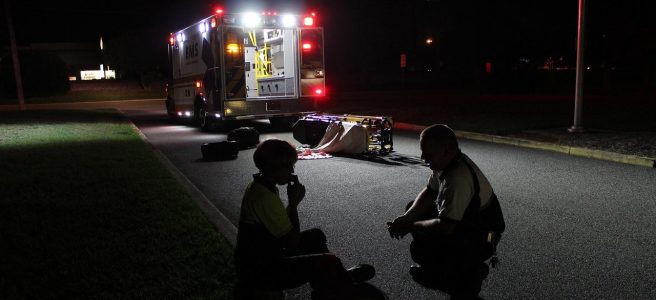
The powerful tool cut through the pedal’s thick metal shaft and David was set free. One by one the emergency vehicles left—except the ambulance. With one inch indentations on each side of his leg, the first responders strongly recommended David go the ER. The ambulance delivered us to the hospital where we thankfully learned there was no injury.

Now I come to the point of my story.

The next morning a neighbor came to our door and explained she would not allow her daughter Sarah outside during our fiasco because neighbors shouldn’t stare—they should care. Could they please bring David’s tricycle to a bike shop to be repaired? They hauled the heavy trike into the back of their SUV and returned it a few days later, having borne the burden and paid the expense.

This incident came to mind with clarity last week as I reflected on the parable of the Good Samaritan. Like the man in the story, our neighbor had a responsive heart. She inconvenienced herself to care for us and our provide for our need.

Do you remember Jesus’ words at the end of the parable? “Go and do likewise” (Luke 10:37).

David giving Stacey a ride in his basket.

Finding Hope, 65 Meditations for a Broken Heart

The Biased and the Bold

When asked, “Who is my neighbor?” Jesus told this parable:

A man was left by the roadside, robbed and beaten, bloody and helpless. Two men saw him there. They were religious men, schooled in the Torah, serving at the synagogue. They each crossed the street to walk on the other side, eyes averted, robes clean and unsoiled. They not only scorned the bleeding victim but also the man who followed behind them, a Samaritan.

The Samaritan was deemed inferior, not good enough for the religious men or worthy of their attention. But—he stopped to help the beaten man. He did not avoid him by crossing to the other side, but stooped to bind his wounds. And then he went the extra mile, figuratively and literally. He lifted the injured man to his own donkey and brought him to an inn, promising to return and pay any expenses his patient may incur.

As familiar as I am with this parable, it touched me anew. I stopped reading and confessed my reticence to be inconvenienced.

Everyone is our neighbor and we are all expected to be first responders. We are all called to show “Samaritan” mercy. Jesus ends His parable in Luke 10:37 with these words,

“Go and do likewise.”

God, give us responsive hearts.

Finding Hope, 65 Meditations for a Broken Heart
The Wheat and the Weeds

Jesus told this parable: A land owner sowed good seed in his field, but that night his enemy came and planted weeds among the wheat. After time, both sprouted. His servants asked the owner if he wanted them to pull up the weeds. He answered, “No… because while you are pulling the weeds, you may root up the wheat with them. Let both grow together until the harvest” (Matthew 13:29).

Weeds are aggressive in their attempt to smother what is holy. They spread twisted half-truths and send out tendrils of intimidation. We do our best to make right choices, resist our lower nature, and be good. We depend on God to water, nourish, and shine on us. We fight to thrive and be all God designed us to be, and do all He planned for us.

If we had our way, we would have the weeds pulled up but our Father sees danger in that—His precious wheat may be prematurely uprooted in the process. Ever protective of His own, He will not endanger us by pulling up the weeds—so we coexist. Until it’s harvest time.

Wheat is not planted to create a pretty field but to be harvested. So we wait, among the weeds, for the day of harvest when our Father will separate us for Himself and bring us safely home.

The Son of Man will send out his angels,
and they will weed out of his kingdom everything that causes sin and all who do evil.
Then the righteous will shine like the sun in the kingdom of their Father.

Matthew 13:41, 43

Finding Hope, 65 Meditations for a Broken Heart

Image by Petra from Pixabay